Introduction
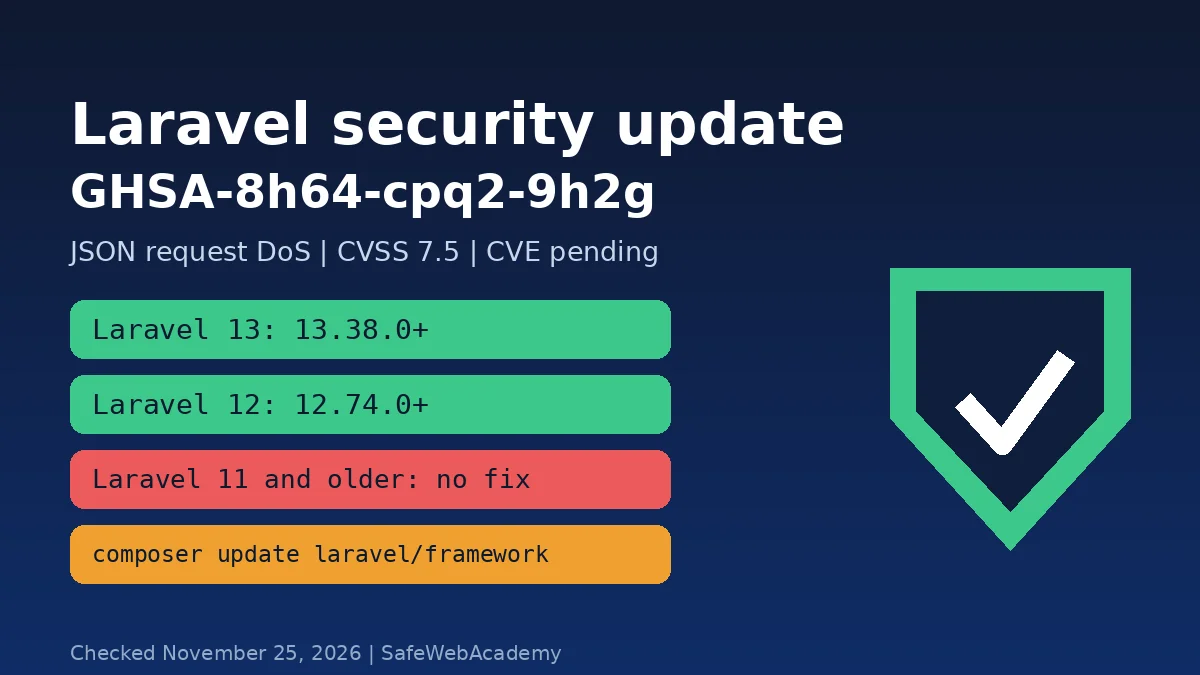
A new Laravel security update fixes a high-severity denial-of-service (DoS) flaw in the framework’s request handling. On November 23, 2026, the Laravel team published advisory GHSA-8h64-cpq2-9h2g. It warns that a crafted JSON request of ordinary size can make an application burn far too much CPU and memory.
According to the advisory, an unauthenticated attacker can send a few of these requests at once, use up every PHP worker and take the application offline. The fix is in laravel/framework 13.38.0 and 12.74.0. This guide explains who is affected, how to check your version and how to update, without exploit details.
Key Facts: Laravel Security Update at a Glance
- What: denial of service through a crafted JSON request body (GitHub advisory GHSA-8h64-cpq2-9h2g, published November 23, 2026).
- Component: the
TransformsRequestmiddleware used by the default global middlewareTrimStringsandConvertEmptyStringsToNull. - Affected:
laravel/frameworkbelow 13.38.0 on Laravel 13 and below 12.74.0 on Laravel 12. Older branches no longer receive security fixes. - Fixed in: 13.38.0 (released October 20, 2026) and 12.74.0 (released November 24, 2026). The newest releases on November 28, 2026 are still 13.44.1 and 12.74.0.
- Severity: “High”, CVSS v3.1 7.5 (
AV:N/AC:L/PR:N/UI:N/S:U/C:N/I:N/A:H), as scored in the Laravel advisory. - CVE: pending. No CVE ID had been assigned as of November 28, 2026.
- Exploitation: the official advisory does not report exploitation, and the flaw is not in the CISA KEV catalog (version 2026.11.27).
- Action: run
composer update laravel/framework, deploy, and restart PHP workers.
What Is the Laravel JSON Request DoS Vulnerability?
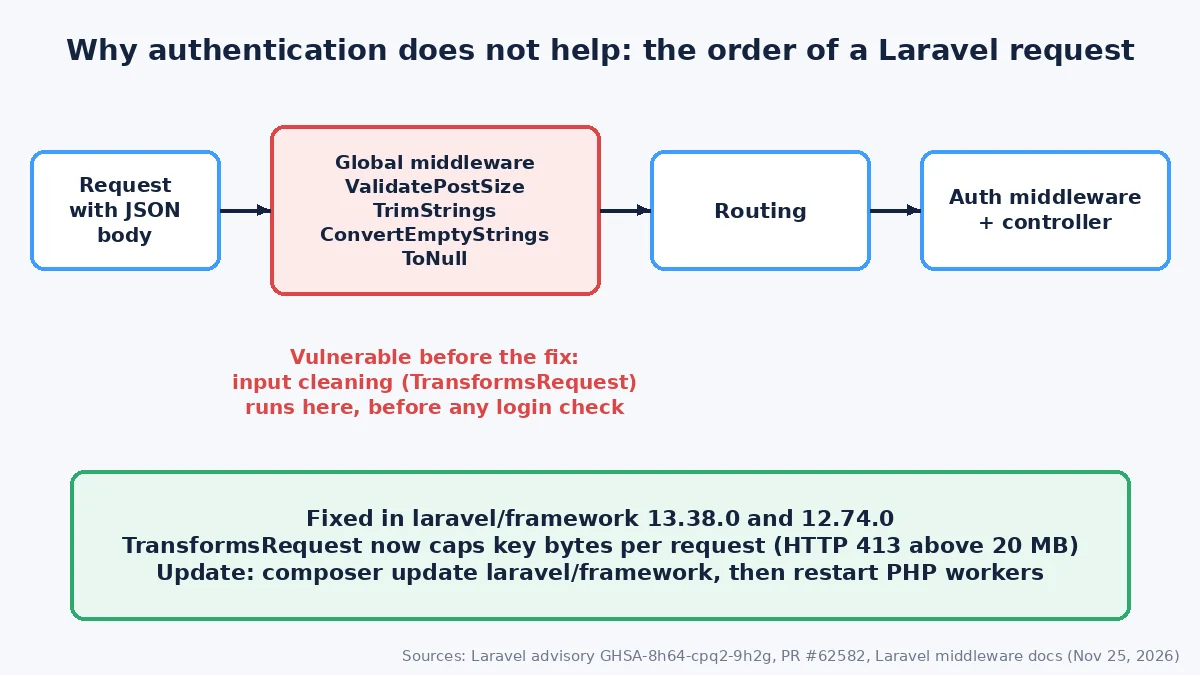
It is an algorithmic resource-exhaustion bug in the code that cleans request input before your controllers see it. Laravel trims strings and converts empty strings to null for every request through the TrimStrings and ConvertEmptyStringsToNull middleware. Both build on a shared helper called TransformsRequest.
The pull request that backported the fix to Laravel 12 describes the cause. The helper rebuilt a full key name for every element of a nested array. With unusually long keys and large arrays, the work grew far faster than the size of the request. The pull request reports that a JSON body of under 1 MB could cause about 30 seconds of CPU time.
Why does a login page not protect my app?
Because the vulnerable middleware is global. Laravel’s documentation lists TrimStrings and ConvertEmptyStringsToNull in the default global middleware stack. According to the fix’s pull request, they run before routing and authentication, so any endpoint that accepts a JSON body is enough.
Which Laravel Versions Are Affected?
Every Laravel 12 and 13 release before the fixed versions is affected, and the advisory’s range also covers older, unsupported branches.
| Laravel branch | Affected laravel/framework versions | Fixed version | Security support (Laravel policy) |
|---|---|---|---|
| 13.x | 13.0.0 to 13.37.x | 13.38.0 or later (latest: 13.44.1) | until March 17, 2028 |
| 12.x | 12.0.0 to 12.73.x | 12.74.0 or later | until February 24, 2027 |
| 11.x and older | all versions (advisory range: below 12.74.0) | none | ended (Laravel 11: March 12, 2026) |
Laravel 13 users got the fix weeks before the advisory, in 13.38.0. Laravel 12 users had to wait for 12.74.0, released on November 24, 2026, one day after the advisory.
What Is the Security Impact?
The impact is availability only: an attacker can make your site slow or unreachable. The advisory does not describe any data theft or code execution, and its CVSS vector rates confidentiality and integrity impact as none.
Still, the attack is cheap. It needs no account, the requests are small, and a handful of parallel requests can occupy every PHP-FPM worker. Typical body-size limits such as PHP’s post_max_size or nginx’s client_max_body_size do not stop it, because the payload stays small. APIs, webhooks and single-page apps that accept JSON are the most obvious targets.
How Can I Check Whether I Am Affected?
Check the installed laravel/framework version in each application and environment. The version that counts is the one in composer.lock on your servers, not the constraint in composer.json.
# Show the installed framework version
composer show laravel/framework | grep versions

# Or ask Artisan
php artisan --version
You are affected if the result is below 13.38.0 on Laravel 13 or below 12.74.0 on Laravel 12. Any Laravel 11 or older install is affected and has no fix.
Will composer audit find this Laravel security update?
Not reliably yet. When we checked the Packagist security-advisory API on November 28, 2026, it still did not list GHSA-8h64-cpq2-9h2g for laravel/framework. Run composer audit for other issues, but compare the version numbers manually for this one.
How Do I Apply the Laravel Security Update?
Update laravel/framework to the latest patch release of your branch, deploy it, and restart the processes that serve PHP. Minor Laravel releases follow semantic versioning and should not contain breaking changes.
# In your project, on a branch
composer update laravel/framework --with-all-dependencies
php artisan --version

# After deploying: reload long-running workers
php artisan octane:reload   # only if you use Laravel Octane
sudo systemctl reload php8.4-fpm   # adjust to your PHP version
Run your test suite before deploying, as with any dependency update. Rebuild container images that bundle the application, because an old vendor/ directory keeps the old code.
What changes after the update?
According to the fix’s pull request, TransformsRequest now counts key bytes per request. If the total exceeds a limit of 20 MB, Laravel stops and returns HTTP 413 (PostTooLargeException). Custom middleware that extends TransformsRequest can override the limit through $maxKeyBytes. Normal forms and API payloads stay far below it.
Is there a workaround if I cannot update today?
The advisory does not list an official workaround, so updating is the only real fix. Until you can deploy, reduce the damage with rate limiting for JSON endpoints and sensible PHP timeouts such as request_terminate_timeout in PHP-FPM. Also watch worker saturation and response times. These steps limit impact but do not remove the flaw.
Additional Security Recommendations
- Patch the whole stack. The PHP 8.5.13, 8.4.28, 8.3.37 and 8.2.36 security update also matters for Laravel servers.
- Rate-limit at the edge. A reverse proxy or a web application firewall can cap request rates per client before PHP workers are busy.
- Monitor PHP-FPM. Alert when all workers are busy or the listen queue grows.
- Watch Laravel advisories. Subscribe to the security advisories of the
laravel/frameworkrepository on GitHub. - Plan upgrades. Laravel 12 loses security fixes on February 24, 2027.
- Review Symfony components. Laravel ships Symfony packages. After you update Laravel, also review the November 2026 Symfony security update and run
composer audit.
FAQ
Do I need this Laravel security update if my app has no public API?
Yes. Every request with a JSON body passes through the global middleware before routing, whatever URL it targets. A public API is not required.
Does this vulnerability let attackers steal data?
No evidence suggests that. The advisory describes only CPU and memory exhaustion, and its CVSS vector rates confidentiality and integrity impact as none.
Is there a CVE ID for GHSA-8h64-cpq2-9h2g?
Not yet. As of November 28, 2026, the advisory has no CVE ID. The GHSA ID, the affected ranges and the fixed versions are official.
Is the Laravel JSON DoS being exploited?
The official advisory does not report exploitation, and as of November 28, 2026 the flaw is not in the CISA KEV catalog (version 2026.11.27). Public advisories often lead to attack attempts, so update soon.
Did the same week bring other Laravel security fixes?
Yes. Medium-severity advisory GHSA-cq3g-fj94-c8p3 (validation rules skipped for empty array keys) is fixed in 13.43.0 and 12.73.0. GHSA-cvfq-f547-rv2g (DoS in email validation) is fixed in 13.43.0 and 12.72.0. On November 25, 2026, Laravel also published high-severity advisory GHSA-c25c-x5r7-2v5m (numeric validation can exhaust resources via extreme exponent input), fixed in 13.44.1 and 12.74.0. Updating to 13.44.1 or 12.74.0 covers all four.
Conclusion
This Laravel security update closes a cheap, unauthenticated DoS in the framework’s global input middleware. Check laravel/framework in every environment and update to 13.38.0 or 12.74.0 or later, ideally the newest patch release. Then restart PHP workers. Plan a move off Laravel 11 or older, because those branches will not be fixed.
References
All links below were checked on November 28, 2026.
- Laravel advisory GHSA-8h64-cpq2-9h2g: Denial of service via crafted JSON request body
- Laravel pull request #62582: Backport TransformsRequest key byte limit
- laravel/framework v12.74.0 release and v13.38.0 release
- Laravel advisory GHSA-cq3g-fj94-c8p3, GHSA-cvfq-f547-rv2g and GHSA-c25c-x5r7-2v5m
- Laravel 13 release notes and support policy
- Laravel documentation: Middleware
- laravel/framework on Packagist
- CISA Known Exploited Vulnerabilities catalog
Related Articles
- PHP 8.5.13, 8.4.28, 8.3.37 and 8.2.36 Security Update: What to Patch Now
- October 2026 PHP vulnerability update and fixes
- Complete Guide to Web Application Firewall WAF
- OWASP Top 10 Explained: A Practical Guide to Website Security
- Nginx CVE-2026-132779: ssl_early_data CPU Flaw Fixed in 1.30.8 and 1.31.10
- Symfony Security Update: 23 CVEs Fixed in 8.1.12, 7.4.24, 6.4.51 and 5.4.57
- What Is a CVE? CVE Meaning, Vulnerability Databases, Scoring and Triage
Last Verified: November 28, 2026. Prepared by SafeWebAcademy from the official Laravel security advisories, the laravel/framework releases and pull request, and the Laravel documentation linked above. This is not an official Laravel publication. Security details can change, so check the linked advisories for updates.