Introduction
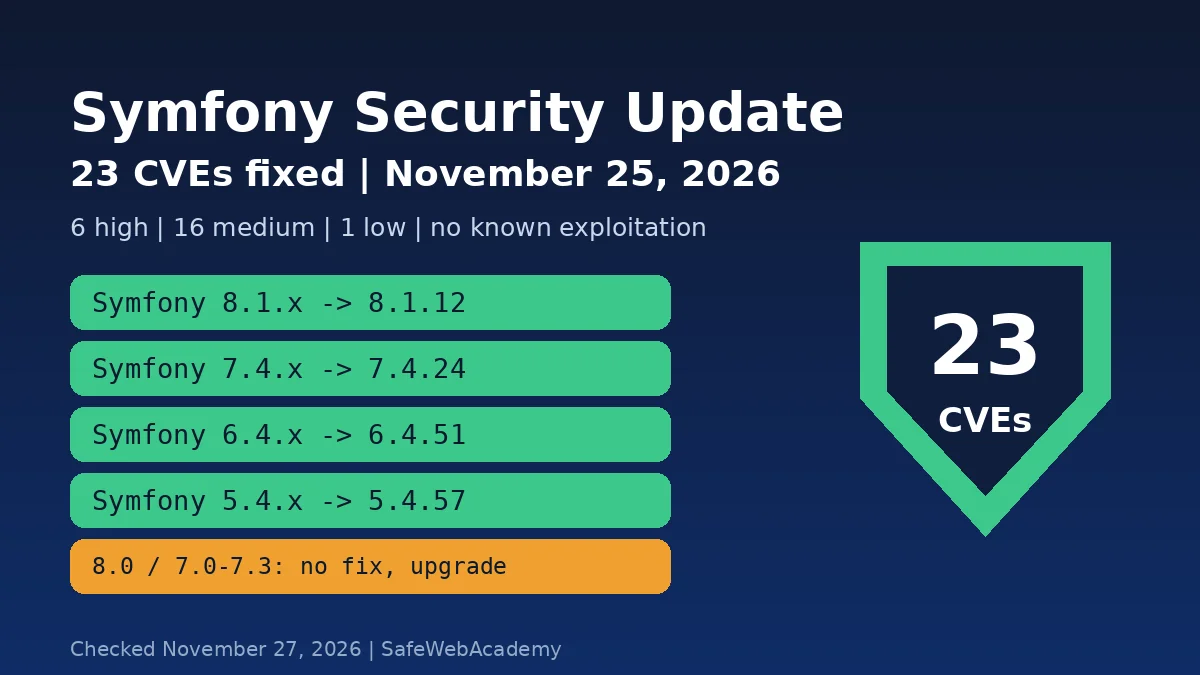
The Symfony security update of November 25, 2026 fixes 23 vulnerabilities in Symfony components, and six of them are rated high. Symfony released 8.1.12, 7.4.24, 6.4.51 and 5.4.57 the same morning. If you run a Symfony application, or a PHP project built on Symfony components such as Drupal or Laravel, plan the update this week.
This guide summarizes the official advisories and shows how to check and update your project. It contains no exploit details.
Key Facts: Symfony Security Update at a Glance
- What: 23 security fixes in Symfony components, published November 25, 2026 (releases 09:17-09:31 UTC, 11:17-11:31 Kyiv time).
- IDs: CVE-2026-133743 to CVE-2026-133762 and CVE-2026-134790 to CVE-2026-134792, each with a GitHub advisory in the symfony/symfony repository.
- Severity: 6 high, 16 medium, 1 low (GitHub advisory ratings). Symfony, the CVE numbering authority, gives CVSS v4.0 scores from 2.3 to 8.7. NVD has not added its own scores yet.
- Fixed in: 8.1.12, 7.4.24, 6.4.51 and 5.4.57. The 7.4 and 8.1 releases contain all 23 fixes; 6.4.51 lists 16 and 5.4.57 lists 15, because many bugs only exist in newer code.
- Exploitation: no known exploitation. None of the CVEs is in the CISA KEV catalog (version 2026.11.25), and CISA’s assessment on the CVE records says “Exploitation: none” where present.
- Action: run
composer update "symfony/*"within your branch, test, deploy and restart long-running PHP workers.
Which Vulnerabilities Does the Symfony Security Update Fix?
The six high-severity issues are two denial-of-service bugs in ExpressionLanguage, one in the Serializer, two HttpClient credential or proxy leaks, and an HttpKernel URL injection.
| CVE | Component | Issue (from the advisory) | CVSS v4.0 |
|---|---|---|---|
| CVE-2026-134791 | ExpressionLanguage | Unclosed /* comments make the lexer quadratic, so untrusted expressions can hold a process | 8.7 |
| CVE-2026-133760 | ExpressionLanguage | Nested short ternaries make the nesting check exponential | 8.7 |
| CVE-2026-133761 | Serializer | CsvEncoder nests rows once per key separator; a small CSV body can crash PHP | 8.7 |
| CVE-2026-134792 | HttpClient | In HTTP workers under the CLI SAPI, a request’s Proxy header can choose the proxy for outgoing requests | 8.3 |
| CVE-2026-133757 | HttpClient | NoPrivateNetworkHttpClient sends default credentials to other origins on redirects | 8.2 |
| CVE-2026-133743 | HttpKernel | Inline fragments let forwarded headers change asset() and absolute_url() URLs (incomplete fix for CVE-2026-123339) | 7.0 |
What are the medium and low issues?
The other 17 issues have narrower conditions, such as a specific configuration or a man in the middle:
- HttpClient and FrameworkBundle:
CachingHttpClientcan share responses between users when credentials are set withwithOptions()(CVE-2026-133750); cached scoped clients send their credentials to any origin (CVE-2026-133747);NoPrivateNetworkHttpClientmakes the decorated client ignore its own default options, such as certificate pinning (CVE-2026-133758) and lets IPv4-mapped addresses through custom subnets (CVE-2026-133748). - Redirects and URLs: login redirect host check bypass when the session cookie domain is set (CVE-2026-134790), UrlGenerator host issues (CVE-2026-133754, CVE-2026-133746), and
//paths in router redirects (CVE-2026-133745). - Security: the
unanimousstrategy grantsaccess_controlrules when only one role matches (CVE-2026-133753); the Doctrine remember-me provider accepts outdated tokens (CVE-2026-133759); Guard logins skipcheckPostAuth()(CVE-2026-133749, low, 5.4 only). - Other components: full exception dumps from CLI-SAPI HTTP workers without
APP_RUNTIME_MODE(CVE-2026-133762),#[Ignore]bypass in the Serializer (CVE-2026-133752), Mailer STARTTLS andrequire_tlsissues (CVE-2026-133755, CVE-2026-133751), HtmlSanitizer meta refresh check (CVE-2026-133756) and JsonPath denial of service (CVE-2026-133744).
Which Symfony Versions Are Affected?
Every maintained branch below the November 25 releases has at least one of these flaws, and unmaintained branches get no fix.
| Symfony branch | Fixed in | Fixes in release | Support status (symfony.com) |
|---|---|---|---|
| 8.1.x | 8.1.12 | 23 | Maintained until January 2027 |
| 8.0.x | No fix | – | End of life since July 2026, upgrade to 8.1 |
| 7.4.x (LTS) | 7.4.24 | 23 | Security fixes until November 2029 |
| 7.0.x to 7.3.x | No fix | – | Unmaintained, upgrade to 7.4 |
| 6.4.x (LTS) | 6.4.51 | 16 | Security fixes until November 2027 |
| 5.4.x (LTS) | 5.4.57 | 15 | Security fixes only, until February 2029 |
Exact ranges differ per CVE: for example, CVE-2026-134791 affects ExpressionLanguage only from 7.2.0, and CVE-2026-133760 only from 5.4.54, 6.4.48, 7.4.21 and 8.1.9.
What Is the Security Impact?
The realistic impact depends on which components your app uses and how it receives requests.
- Denial of service: apps that lint, parse or evaluate untrusted expressions, including the
ExpressionSyntaxvalidator, or decode untrusted CSV with the Serializer, can be stalled or crashed with small inputs. - Credential and data leaks: apps that call other services with HttpClient can leak credentials to other origins or route traffic through an attacker-chosen proxy. CVE-2026-134792 and CVE-2026-133762 only affect HTTP workers under the CLI SAPI, such as the RoadRunner runner of php-runtime. Symfony says FrankenPHP’s worker mode sets
APP_RUNTIME_MODEand is not affected by CVE-2026-133762. - Script injection: CVE-2026-133743 can make pages load assets from another host when a TLS terminator, proxy or cache on the same host forwards requests from
127.0.0.1. Symfony says apps served directly by php-fpm or mod_php are not affected.
How Do I Check Whether My Project Is Affected?
Check the installed Symfony packages first, then let Composer compare them with the advisory database.
composer show "symfony/*"
composer audit
composer why symfony/http-client
Packages below 8.1.12, 7.4.24, 6.4.51 or 5.4.57 need the update. composer audit checks the Packagist advisory database, which already lists these CVEs. composer why shows which package pulled a component in.
Is my Drupal or Laravel site affected?
Possibly, because both ship Symfony components, but whether a specific CVE applies depends on the code paths used. Drupal’s drupal/core-recommended 11.4.14 and 11.3.23 pin components with ~v7.4.23, and 10.6.23 with ~v6.4.50, so the patch releases fit those constraints. Laravel 13.44.1 requires components such as http-foundation, http-kernel, routing and mailer at ^7.4.0 || ^8.0.0. Run composer audit in each project.
How Do I Apply the Symfony Security Update?
Update the Symfony packages within your current branch, test, deploy and restart every long-running process.
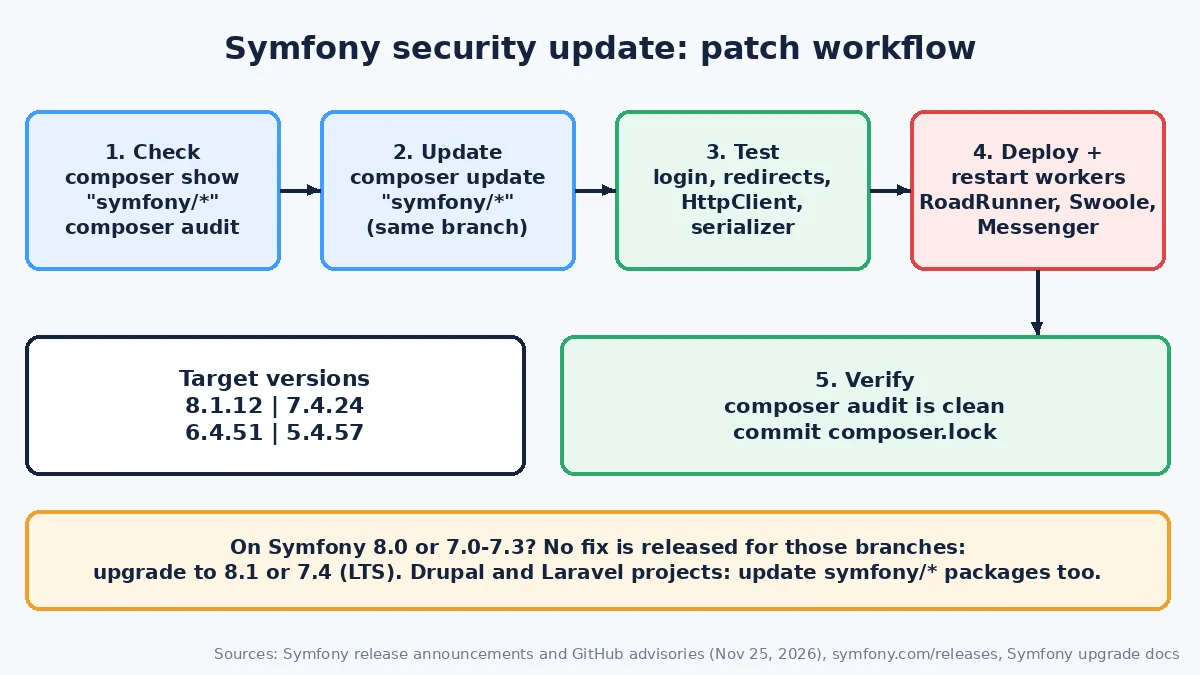
- Back up and use a branch or staging copy.
- Update the packages. Symfony’s upgrade guide uses
composer update "symfony/*"; add--with-all-dependenciesif Composer reports a dependency conflict. - Run your tests, especially login, redirects, HttpClient calls and serializer endpoints.
- Deploy and restart workers. RoadRunner, FrankenPHP worker mode, Swoole and Messenger consumers keep old code in memory until they restart.
- Re-run
composer auditand commit the updatedcomposer.lock. - Plan branch upgrades. On 8.0 or 7.0-7.3, move to 8.1 or 7.4. Symfony 6.4 bug-fix support ends in November 2026.
Additional Security Recommendations
- Configure trusted proxies explicitly using Symfony’s guide for load balancers and reverse proxies.
- Use a Content Security Policy so injected script URLs from another host are blocked. See our HTTP security headers guide.
- Keep PHP patched too. Our PHP 8.5.13, 8.4.28, 8.3.37 and 8.2.36 security update guide covers the runtime.
- Subscribe to Symfony’s security notifications on its releases page.
FAQ
Is the Symfony security update urgent?
It is important, but there is no sign of exploitation. Six fixes are rated high and none is in CISA KEV as of November 27, 2026. Update this week and sooner if you parse untrusted expressions or CSV, or run CLI-SAPI HTTP workers.
Which Symfony version should I install?
Install the newest release of your branch: 8.1.12, 7.4.24, 6.4.51 or 5.4.57. Symfony 8.0 and 7.0-7.3 get no fix.
Do I need to update symfony/symfony or each component?
Update whatever your composer.json requires. The advisories list both the individual packages and the symfony/symfony package with the same fixed versions.
Do these CVEs have NVD scores?
Not yet. As of November 27, 2026, NVD lists the records as “Received”. The CVSS v4.0 scores come from Symfony as CNA. Our guide What Is a CVE? explains how CNAs and NVD differ.
Does the Drupal CVE-2026-136716 update include these Symfony fixes?
No. Drupal’s November 25 release notes say the same-day Symfony security update is not included, so update Symfony packages separately. See our Drupal CVE-2026-136716 guide.
Conclusion
The November 2026 Symfony security update fixes 23 CVEs across HttpClient, ExpressionLanguage, Serializer, HttpKernel and Security. Update to 8.1.12, 7.4.24, 6.4.51 or 5.4.57, restart your workers and add composer audit to your pipeline.
References
- Symfony 8.1.12 released, 7.4.24, 6.4.51 and 5.4.57
- Symfony security advisories (official blog)
- symfony/symfony GitHub security advisories
- GHSA-5vf6-gchv-cmcr (CVE-2026-134791), GHSA-fvvg-g68p-p6q9 (CVE-2026-133760), GHSA-4xg9-mw5c-qq5p (CVE-2026-133761)
- GHSA-cjfx-x9pc-q4rx (CVE-2026-134792), GHSA-v6qm-94rx-6×93 (CVE-2026-133757), GHSA-8cww-v5fg-2mf9 (CVE-2026-133743)
- CVE-2026-134791 on CVE.org and NVD
- Symfony releases and support periods
- Symfony docs: Upgrading a minor or patch version
- Symfony docs: Working behind a load balancer or reverse proxy
- Composer CLI: audit
- CISA Known Exploited Vulnerabilities catalog
Related Articles
- PHP 8.5.13, 8.4.28, 8.3.37 and 8.2.36 Security Update: What to Patch Now
- Drupal CVE-2026-136716: Patch the Installer Access Bypass (SA-CORE-2026-019)
- HTTP Security Headers: What to Set, How to Configure Them and How to Test
- What Is a CVE? CVE Meaning, Vulnerability Databases, Scoring and Triage
- OWASP Top 10 (2025) Explained: A Practical Guide to Web Application Security
Last Verified: November 27, 2026. Prepared by SafeWebAcademy from the official Symfony release announcements and security advisories, the GitHub advisory records, CVE.org and NVD, Packagist metadata and the CISA KEV catalog linked above. This is not an official Symfony publication. Security details can change, so check the linked advisories for updates.