Introduction
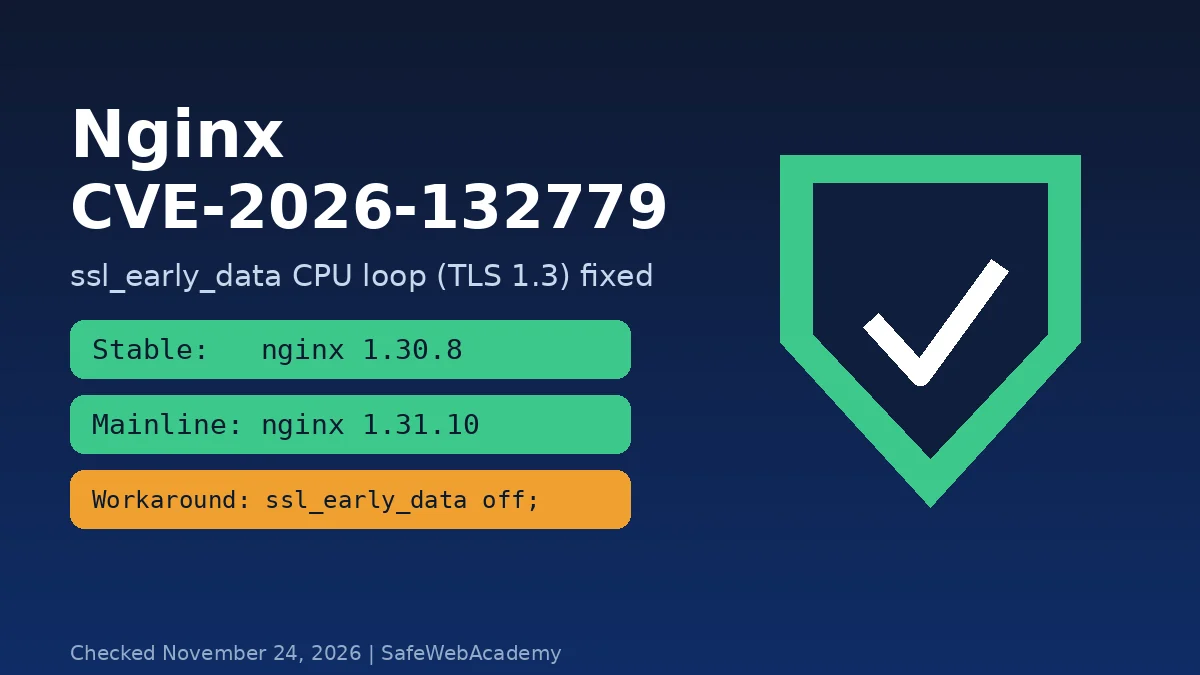
Nginx CVE-2026-132779 is a denial-of-service flaw that affects servers with TLS 1.3 early data turned on through the ssl_early_data on directive. On November 23, 2026, the nginx project released nginx 1.30.8 (stable) and 1.31.10 (mainline) to fix it.
A crafted TLS 1.3 connection can push an nginx worker into a loop that keeps one CPU core at 100%. The setting is off by default, so many servers are not exposed. This comes only five days after the nginx 1.30.7 and 1.31.9 security update, so even recently patched servers need another upgrade. This article explains who is affected, how to check, and how to fix it, without exploit details.
Key Facts: Nginx CVE-2026-132779 at a Glance
- What: excessive CPU usage in TLS 1.3 when
ssl_early_datais enabled (CVE-2026-132779). - Fixed in: nginx 1.30.8 (stable) and 1.31.10 (mainline), both released November 23, 2026.
- Affected: nginx 1.21.4 through 1.31.9, but only when
ssl_early_data onis configured. NGINX Plus is also affected (see the version table). - Severity: “medium” on nginx.org. F5, the CVE Numbering Authority, scores it 6.9 in CVSS v4.0 and 5.3 in CVSS v3.1. NVD had not analyzed it yet (“Awaiting Analysis”).
- Exploitation: none reported as of November 24, 2026. The CVE is not in the CISA KEV catalog (version 2026.11.23). F5 lists the discovery as internal.
- Workaround: set
ssl_early_data off;, as documented by F5. - Action: upgrade to 1.30.8 or 1.31.10, or turn early data off until you can.
What Is Nginx CVE-2026-132779?
It is a bug that can trap an nginx worker in a tight loop when a client uses TLS 1.3 early data. According to the F5 CVE record, a specially crafted TLS 1.3 connection makes the worker repeat the same send without ever making progress. The record names ngx_http_write_filter_module as the affected module and classifies the bug as CWE-835 (loop with unreachable exit condition).
What is TLS 1.3 early data?
Early data, also called 0-RTT, lets a returning client send its first request together with the TLS handshake. It is defined in RFC 8446. It saves one round trip, but nginx’s documentation warns that requests sent in early data are subject to replay attacks. In nginx, the ssl_early_data directive turns it on. It has existed since nginx 1.15.3, and its default is off.
Which Versions Are Affected by Nginx CVE-2026-132779?
Every nginx release from 1.21.4 up to 1.31.9 is vulnerable when early data is enabled, according to the nginx.org advisory.
| Product / branch | Affected | Fixed in |
|---|---|---|
| nginx 1.31 mainline | 1.31.0 to 1.31.9 | 1.31.10 |
| nginx 1.30 stable | 1.30.0 to 1.30.7 | 1.30.8 |
| nginx 1.28 and older legacy lines | from 1.21.4 | No fix; upgrade to 1.30.8 or 1.31.10 |
| NGINX Plus 37.1 line | 37.1.0 up to, but not including, 37.3.1.1 | 37.3.1.1 (per CVE record) |
| NGINX Plus 37.0 line | 37.0.0 up to, but not including, 37.0.9.1 | 37.0.9.1 (per CVE record) |
| Other NGINX Plus releases from R33 | listed as affected in the CVE record | Check F5 K000163947 |
The download page still lists legacy versions 1.28.3 and 1.26.3, and neither includes this fix. F5 notes that versions past End of Technical Support were not evaluated. Linux distributions may backport the fix without changing the version, so also check your vendor’s security tracker.
What Is the Security Impact?
The main risk is reduced performance and possible denial of service on servers that have early data enabled. F5 explains that the stuck worker keeps accepting and handling connections. However, one CPU core stays pinned at 100% until the worker is restarted.
- No login needed: F5 says an unauthenticated attacker could trigger it.
- Availability only: the CVSS vectors rate confidentiality and integrity impact as none.
- Data plane only: F5 states there is no control plane exposure.
- Cumulative effect: each affected worker can lose a core. On a server with few cores, the whole site can slow down.
The same releases also fix a separate bug in which nginx “might hog CPU if SSL connections to backends were used.” It has no CVE, but it is another reason to upgrade.
How Do I Check Whether Nginx CVE-2026-132779 Affects Me?
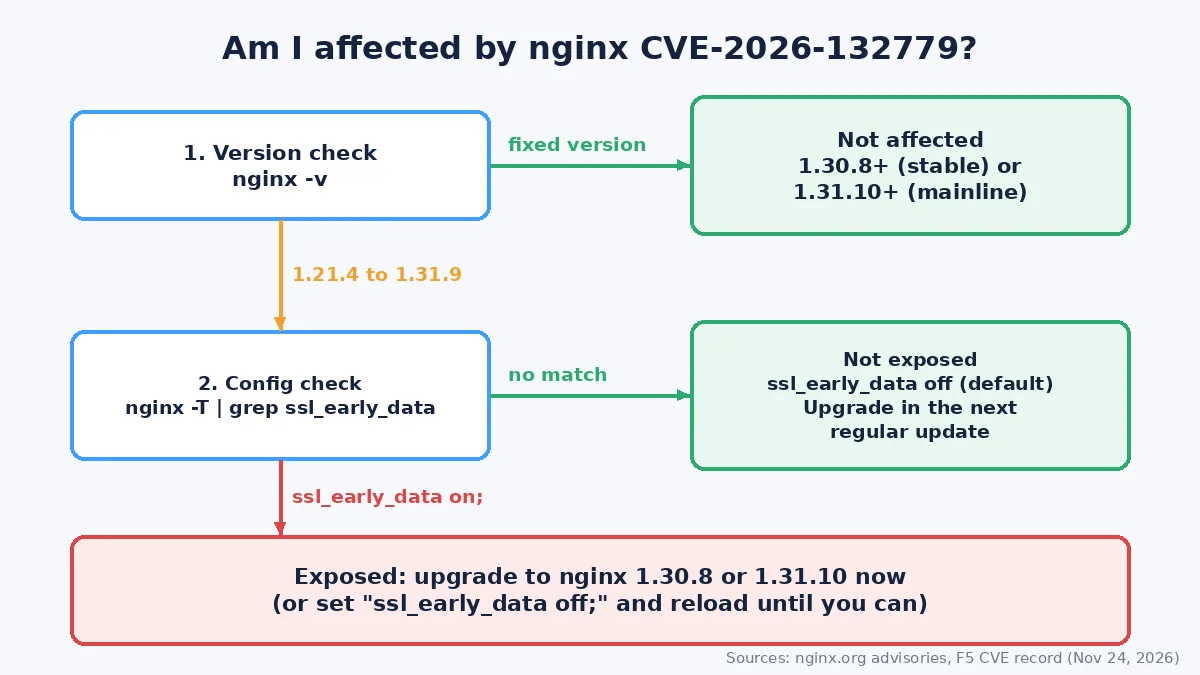
You are affected only if two things are true: your version is in the vulnerable range, and early data is turned on.
How do I check my nginx version?
nginx -vStable 1.30.8 or later, or mainline 1.31.10 or later, is fixed. On Debian, Ubuntu or RHEL packages, compare the package changelog with your distribution’s advisory for CVE-2026-132779.
How do I find ssl_early_data in my configuration?
nginx -T prints the full loaded configuration, including included files:
sudo nginx -T 2>/dev/null | grep -n "ssl_early_data"If there is no output, early data is off (the default). Lines with ssl_early_data on; mean the server is exposed until you upgrade. Also check the default server for each listen address. The nginx docs note that its value can apply to other virtual servers on the same address.
How Do I Fix the Vulnerability?
Upgrade to nginx 1.30.8 or 1.31.10, or install your vendor’s patched package. Then restart or reload nginx so every worker runs the new binary.
- Upgrade. Stay on your branch: stable users move to 1.30.8 and mainline users to 1.31.10. Both include all fixes from 1.30.7 and 1.31.9.
- Test and reload. Run
sudo nginx -t, then reload or restart with your service manager. - Rebuild containers. Update the nginx base image tag and redeploy, because old images keep the old binary.
- Verify. Run
nginx -von every host and container.
What if I cannot upgrade right away?
Use F5’s documented workaround: turn TLS 1.3 early data off.
# in each http or server block that enabled it
ssl_early_data off;
Then run sudo nginx -t and reload. Clients still use TLS 1.3. They only lose the 0-RTT round-trip saving on resumed connections. If a worker is already stuck, restarting nginx frees the CPU core.
Additional Security Recommendations
Keep early data off unless you have measured a real benefit and your application handles replays safely.
- Protect against replays. If you keep early data on after upgrading, pass the
$ssl_early_datavariable to the application (for example,proxy_set_header Early-Data $ssl_early_data;, as shown in the nginx docs). Then refuse non-idempotent requests sent as early data. - Watch CPU per worker. Alert when a single nginx worker stays at 100% CPU. This catches loops like this one and other denial-of-service problems.
- Subscribe to announcements. nginx shipped two security releases in one week. Follow the nginx security advisories page.
- Harden the rest of the stack. Review our HTTP security headers guide and Ubuntu server hardening guide.
- Add a protective layer. A web application firewall and upstream rate limiting reduce the impact of request floods. They are not a replacement for the patch.
FAQ
Is nginx CVE-2026-132779 urgent?
It is urgent only if ssl_early_data on appears in your configuration. In that case, upgrade or disable early data now. If early data is off, include 1.30.8 or 1.31.10 in your next regular update.
Is CVE-2026-132779 being exploited?
No exploitation has been reported as of November 24, 2026. The CVE is not in CISA’s KEV catalog (version 2026.11.23). Whether a public exploit exists is unknown.
I just installed nginx 1.30.7. Do I need to update again?
Yes, if you use early data. Version 1.30.7 is still in the vulnerable range for CVE-2026-132779. Version 1.30.8 contains the earlier fixes plus this one.
Does turning off ssl_early_data break anything?
Normally not. TLS 1.3 and session resumption keep working, and clients simply send their first request after the handshake. Test as usual after reloading.
Is NGINX Plus affected?
Yes. The CVE record lists NGINX Plus 37.1.0 up to 37.3.1.1 and 37.0.0 up to 37.0.9.1 as affected. It also lists other releases from R33 onward as affected. Check F5 article K000163947 for your release.
Conclusion
Nginx CVE-2026-132779 lets a crafted TLS 1.3 early data connection pin an nginx worker at 100% CPU. It only matters when ssl_early_data is on, but then it needs attention. Upgrade to nginx 1.30.8 or 1.31.10, or set ssl_early_data off; until you can, and rebuild any container images that bundle nginx.
References
All links below were checked on November 24, 2026.
- nginx security advisories and nginx.org news (November 23, 2026)
- nginx 1.31.10 changes and nginx 1.30.8 changes
- nginx download page
- CVE-2026-132779 record on CVE.org and NVD entry
- F5 security advisory K000163947
- nginx ngx_http_ssl_module: ssl_early_data
- RFC 8446: TLS 1.3
- CISA Known Exploited Vulnerabilities catalog
Related Articles
- Nginx Security Update: 1.30.7 and 1.31.9 Fix 10 CVEs
- HTTP Security Headers: What to Set, How to Configure Them and How to Test
- Apache HTTP Server 2.4.71: Patch mod_http2 CVE-2026-119618
- How to Secure Your Ubuntu Server: A Beginner-Friendly Guide
- Complete Guide to Web Application Firewall WAF
Last Verified: November 24, 2026. Prepared by SafeWebAcademy from the official nginx.org advisories and changelogs, the F5 CVE record and NVD. This is not an official nginx or F5 publication. Security details can change, so check the linked advisories for updates.