Introduction
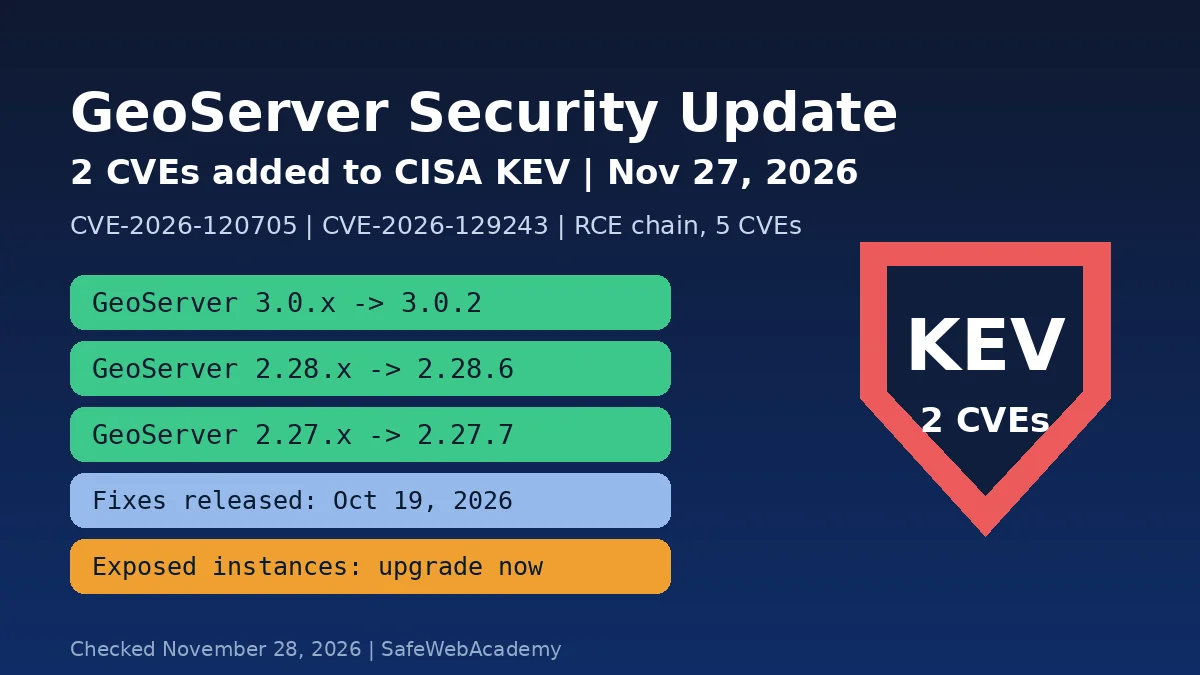
This GeoServer security update matters now because CISA added two GeoServer flaws, CVE-2026-120705 and CVE-2026-129243, to its Known Exploited Vulnerabilities (KEV) catalog on November 27, 2026. The fixes have been available since October 19, 2026, in GeoServer 3.0.2, 2.28.6 and 2.27.7. If you run GeoServer on the internet and have not upgraded, treat this as a priority.
This guide summarizes official GeoServer and CISA information and contains no exploit details.
Key Facts: GeoServer Security Update at a Glance
- What: two unauthenticated GeoServer flaws, an XML injection in the WFS 2.0 GetFeatureById stored query (CVE-2026-120705) and a service-security bypass (CVE-2026-129243), are in the CISA KEV catalog.
- Chain: CISA says they can be chained with CVE-2026-129244, CVE-2026-129245 and CVE-2026-129242 for unauthenticated remote code execution. GeoServer fixed each step separately.
- Affected: GeoServer 2.27.6 and earlier, 2.28.0 to 2.28.5, and 3.0.0 to 3.0.1.
- Fixed in: GeoServer 2.27.7, 2.28.6 and 3.0.2 (released October 19, 2026).
- Severity: GeoServer’s GitHub advisories rate CVE-2026-120705 High (CVSS v3.1 8.6) and CVE-2026-129243 High (CVSS v4.0 8.8). CVE-2026-129245 is rated Critical (CVSS v4.0 9.2).
- Exploitation: CVE-2026-120705 and CVE-2026-129243 were added to KEV on November 27, 2026, with a federal due date of November 30, 2026. KEV marks ransomware campaign use as “Unknown”. The other three chain CVEs are not in KEV as of catalog version 2026.11.27.
- Action: upgrade, restrict the admin interface and REST API, and review your data directory.
What Is the GeoServer Vulnerability Chain?
GeoServer published CVE details for its October releases on November 23, 2026, and the chain consists of five separately fixed steps. Each step has its own GitHub advisory in the geoserver/geoserver repository.
| CVE | Issue (from the advisory) | Rating (GeoServer advisory) |
|---|---|---|
| CVE-2026-129244 | WFS stored query error reveals the data directory path | Medium, CVSS v4.0 6.9 |
| CVE-2026-129243 | Service security rules are skipped when the service name has a prefix | High, CVSS v4.0 8.8 |
| CVE-2026-120705 | Unauthenticated XML injection in the WFS GetFeatureById stored query: local file read and server-side requests | High, CVSS v3.1 8.6 |
| CVE-2026-129245 | Predictable default remember-me key allows administrator session forgery | Critical, CVSS v4.0 9.2 |
| CVE-2026-129242 | Unsafe deserialization in JDBC user and role services lets an administrator run code | High, CVSS v4.0 8.6 |
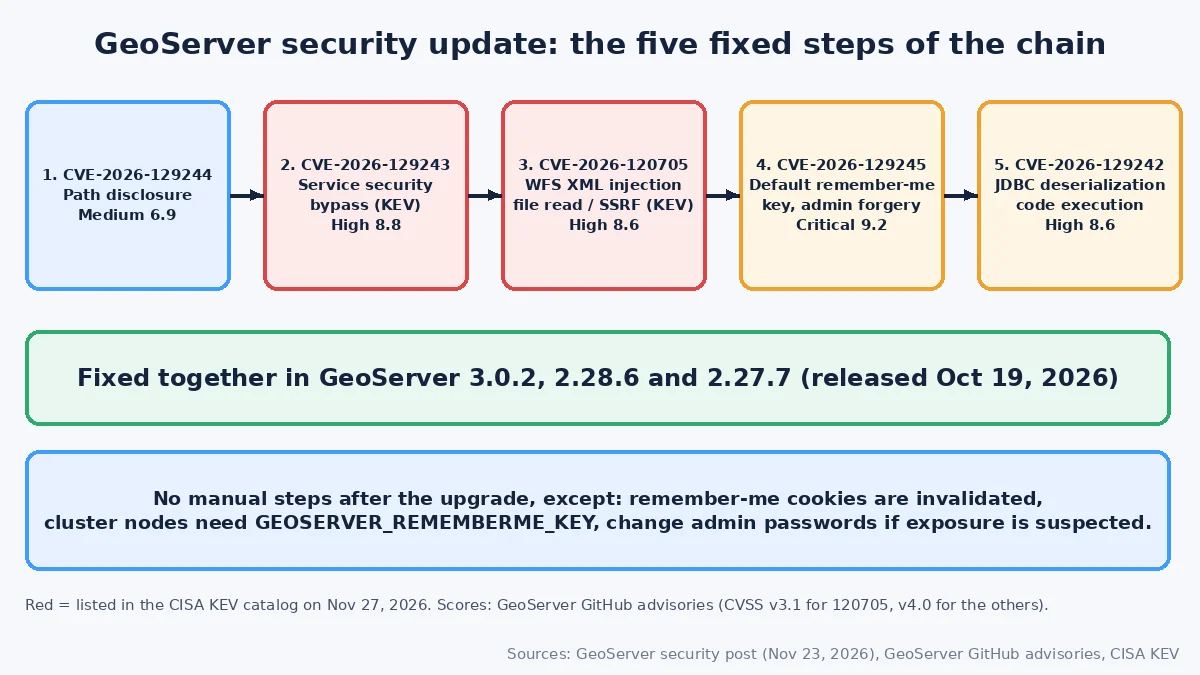
In plain terms: early steps let an unauthenticated visitor learn paths and read files, and later steps turn that into an administrator session and code execution. The advisory for CVE-2026-120705 says file contents are echoed back only when a layer is published to anonymous users.
What else do the October releases fix?
GeoServer’s November 23 post lists 17 CVEs for the October releases: 1 Critical, 12 High and 4 Medium. They include CVE-2026-120704 (code execution through SQLite JDBC extension loading, High) and several server-side request forgery (SSRF) issues. Upgrading fixes all of them.
Which GeoServer Versions Are Affected?
Every GeoServer release before 2.27.7, 2.28.6 and 3.0.2 is affected, according to the GitHub advisories.
| Branch | Affected versions | Fixed in | Status (GeoServer, Nov 23, 2026) |
|---|---|---|---|
| 3.0.x | 3.0.0 to 3.0.1 | 3.0.2 | Current stable |
| 2.28.x | 2.28.0 to 2.28.5 | 2.28.6 | Current maintenance |
| 2.27.x | 2.27.6 and earlier | 2.27.7 | Fixed release published |
Older branches are not listed with fixes. GeoServer says to upgrade to a supported release at least once a year to keep receiving security fixes.
What Is the Security Impact?
Without the GeoServer security update, unauthenticated attackers could read files readable by the GeoServer process, make the server fetch URLs, and, in a chain, take over an administrator session. CISA’s KEV entry describes the chain as leading to unauthenticated remote code execution.
Because CISA lists these as exploited, also review instances that were internet-facing before you upgraded.
How Can I Check Whether I Am Affected?
Check the GeoServer version, then check whether the instance is reachable from outside.
- Version: open the About GeoServer page in the web admin. When you are logged in it lists build information. The documented REST endpoint
/rest/about/versionreports it too. - Exposure: find out whether the
/geoserverweb application or its WFS endpoint is reachable from the internet or from untrusted networks. - Stored queries: the advisory for CVE-2026-129243 asks you to review the
wfs/queryandworkspaces/*/wfs/queryfolders in the data directory for stored queries you did not create. - Administrators: review accounts and recent administrator logins.
# Report the GeoServer version over REST (admin credentials required)
curl -u admin https://gis.example.com/geoserver/rest/about/version.xml
How Do I Apply the GeoServer Security Update?
The GeoServer security update is an upgrade to 3.0.2, 2.28.6 or 2.27.7, which fix all five chain steps.
- Back up your data directory and configuration.
- Download the matching release from the GeoServer download page. Stay on your current branch unless you plan a migration.
- Upgrade and restart the application server.
- Expect side effects: GeoServer says existing remember-me cookies are invalidated on upgrade, and each node now uses a random key. In a cluster, set a shared key with the
GEOSERVER_REMEMBERME_KEYapplication property. - If JDBC security services need extra connection parameters, the fix adds the
GEOSERVER_JDBC_EXTRA_PARAMETERSproperty for that. - Re-check the version on the About page.
What can I do if I cannot upgrade today?
These mitigations come from the GeoServer advisories. They reduce risk but do not replace the upgrade.
| CVE | Vendor-documented mitigation |
|---|---|
| CVE-2026-120705 | Restrict or disable WFS for anonymous users using service security, or disable WFS if you do not need it |
| CVE-2026-129243 | Block requests whose service parameter contains a / at a proxy in front of GeoServer |
| CVE-2026-129245 | Remove rememberme from the web filter chain (Security > Authentication), or set a long random key and protect the data directory |
| CVE-2026-129242 | Limit administrator access and restrict /rest/resource and /rest/security to trusted networks |
| CVE-2026-120704 | Restrict the admin console and REST API, and do not install unneeded JDBC drivers such as SQLite |
Additional Security Recommendations
- Keep admin interfaces private. Put the admin console and REST API behind a VPN or an allow-list. A web application firewall is only an extra layer.
- Run with least privilege. Run GeoServer as a dedicated low-privilege user with limited file and network access.
- Track exploited bugs after this GeoServer security update. Use the CISA KEV catalog as a patch-priority signal. Our guide What Is a CVE? explains KEV, CVSS and triage.
- Plan for incident response. If you find signs of takeover, rotate credentials and rebuild from a trusted backup.
FAQ
Is the GeoServer vulnerability being exploited?
CISA added CVE-2026-120705 and CVE-2026-129243 to KEV on November 27, 2026, which means it has evidence of exploitation. The public KEV entries do not name the attackers or the targets. The other three chain CVEs are not in KEV as of version 2026.11.27.
Which version does the GeoServer security update need?
Install 3.0.2 on the 3.0 branch, 2.28.6 on the 2.28 branch or 2.27.7 on the 2.27 branch. All three were released on October 19, 2026.
Do I need to change passwords after upgrading?
GeoServer says to change administrator passwords if you suspect exposure. The upgrade itself invalidates existing remember-me cookies.
Are CVE records available?
The IDs come from the GeoServer advisories and the CISA KEV catalog. When we checked on November 28, 2026, the CVE.org API and the NVD API did not return records for these IDs yet, so scores here come from the GeoServer GitHub advisories.
Conclusion
This GeoServer security update closes a five-step chain, and CISA says two steps are exploited. Upgrade to 3.0.2, 2.28.6 or 2.27.7, keep the admin console off the public internet and check your data directory and administrator accounts.
References
- GeoServer Security Update – November 2026 (official post)
- GeoServer 3.0.2 release, 2.28.6 and 2.27.7
- GHSA-39mw-5chv-jh47 (CVE-2026-120705)
- GHSA-rv5g-g2r9-58rj (CVE-2026-129243)
- GHSA-hgm3-wq4h-8vvq (CVE-2026-129245)
- GHSA-9wf2-fcgq-vxhq (CVE-2026-129242)
- CISA Known Exploited Vulnerabilities catalog
- CISA BOD 26-04: Prioritizing Security Updates Based on Risk
- GeoServer docs: About GeoServer page
- GeoServer docs: Service security
- GeoServer docs: Authentication (remember me)
- GeoServer docs: Application properties
Related Articles
- Drupal CVE-2026-136716: Patch the Installer Access Bypass (SA-CORE-2026-019)
- Drupal Security Update: Patch the Installer RCE (CVE-2026-132165) Now
- What Is a CVE? CVE Meaning, Vulnerability Databases, Scoring and Triage
- Complete Guide to Web Application Firewall WAF
- OWASP Top 10 (2025) Explained: A Practical Guide to Web Application Security
Last Verified: November 28, 2026. Prepared by SafeWebAcademy from the official GeoServer announcements, GitHub security advisories and documentation, and the CISA KEV catalog linked above. This is not an official GeoServer or OSGeo publication. Security details can change, so check the linked advisories for updates.